Trading Settings in Chart Settings
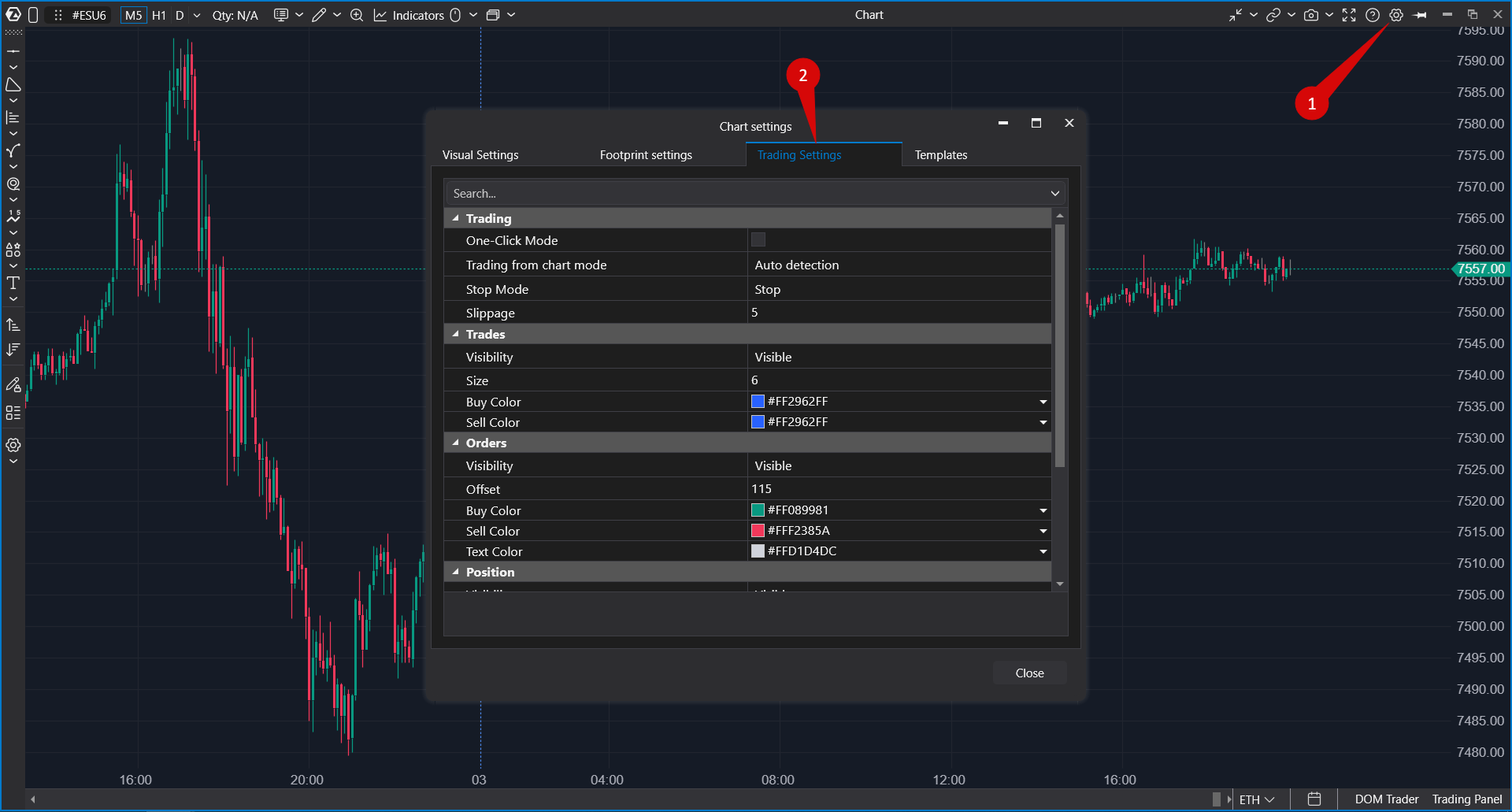
The Trading Settings tab in chart settings controls how orders, trades, and the current position are displayed and placed directly from a chart.
Use this tab to adjust chart trading behavior, enable or disable one-click order submission, change the default stop order type, or customize the appearance of trading objects on the chart.
Opening Trading Settings
To open the Trading Settings tab:
- Open a chart.
- Open the chart context menu or chart settings menu.
- Select Settings.
- Open the Trading Settings tab.
The tab is available in the chart settings window together with other chart configuration tabs, such as visual settings, cluster settings, and templates.
Trading
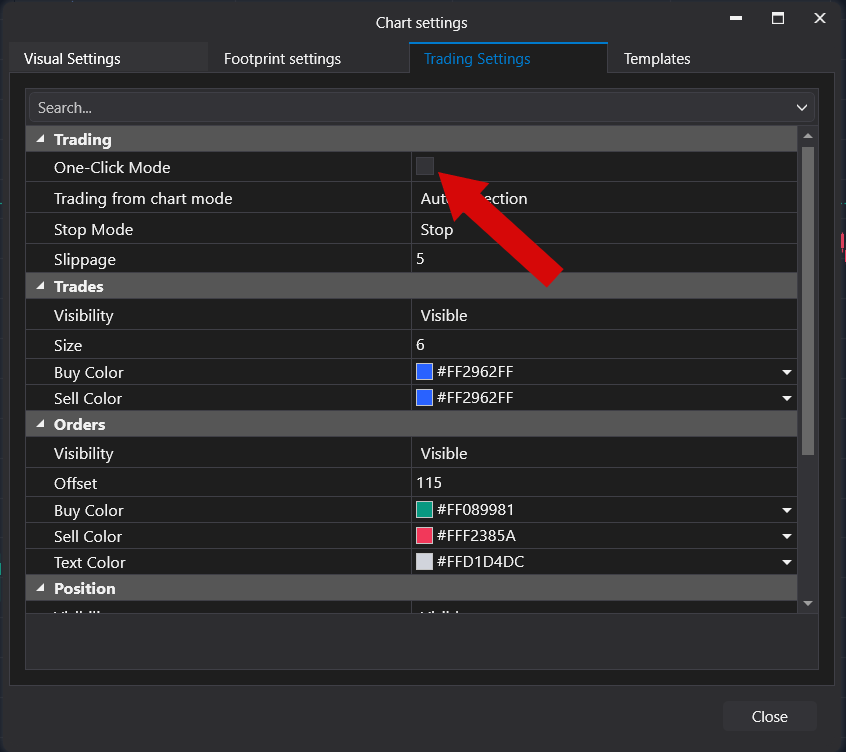
The Trading group controls how orders are submitted from the chart.
One-Click Mode
One-Click Mode allows you to submit orders without an additional confirmation dialog.
When this mode is disabled, ATAS asks for confirmation before placing an order or performing some trading actions. When this mode is enabled, order actions can be sent faster, but accidental clicks can also place orders immediately.
Use One-Click Mode only if you understand the risk of accidental order placement.
Trading From Chart Mode
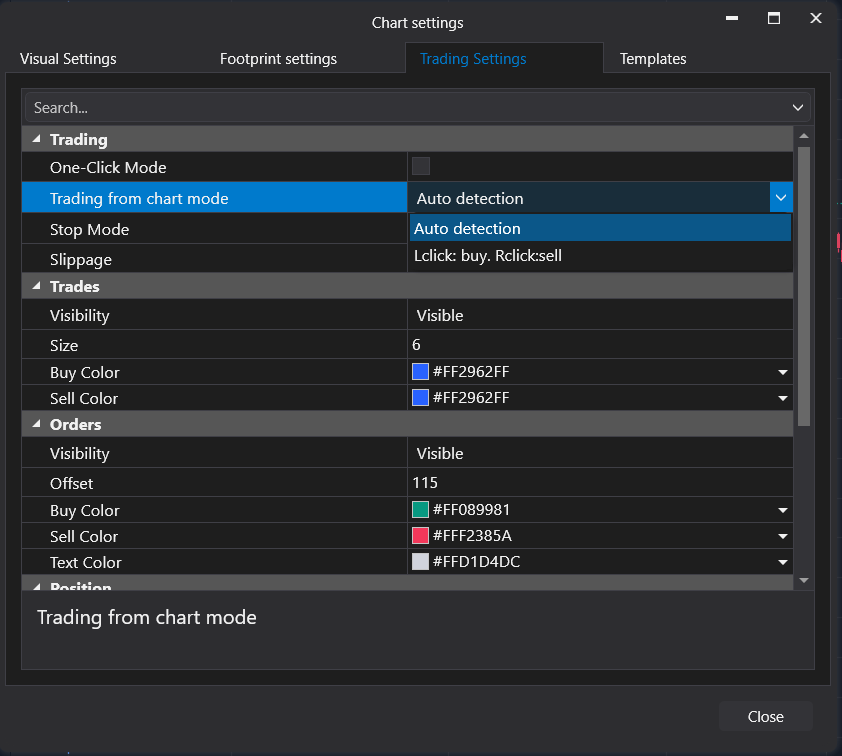
Trading From Chart Mode defines how mouse clicks on the chart are interpreted when trading from the chart is active.
Available modes:
- Auto-Detection — ATAS chooses the order direction and order type based on the clicked price level and mouse button.
- Lclick: Buy. Rclick: Sell — left-click is used for buy orders and right-click is used for sell orders. ATAS still determines whether the order should be a limit or stop order based on the selected price level.
In Auto-Detection mode:
- left-click below or at the best bid places a Buy Limit order;
- left-click above or at the best ask places a Sell Limit order;
- right-click below or at the best bid places a Sell Stop order;
- right-click above or at the best ask places a Buy Stop order.
In Lclick: Buy. Rclick: Sell mode:
- left-click places a buy order;
- right-click places a sell order;
- ATAS chooses limit or stop behavior based on the clicked price level relative to the current best bid and best ask.
Stop Mode
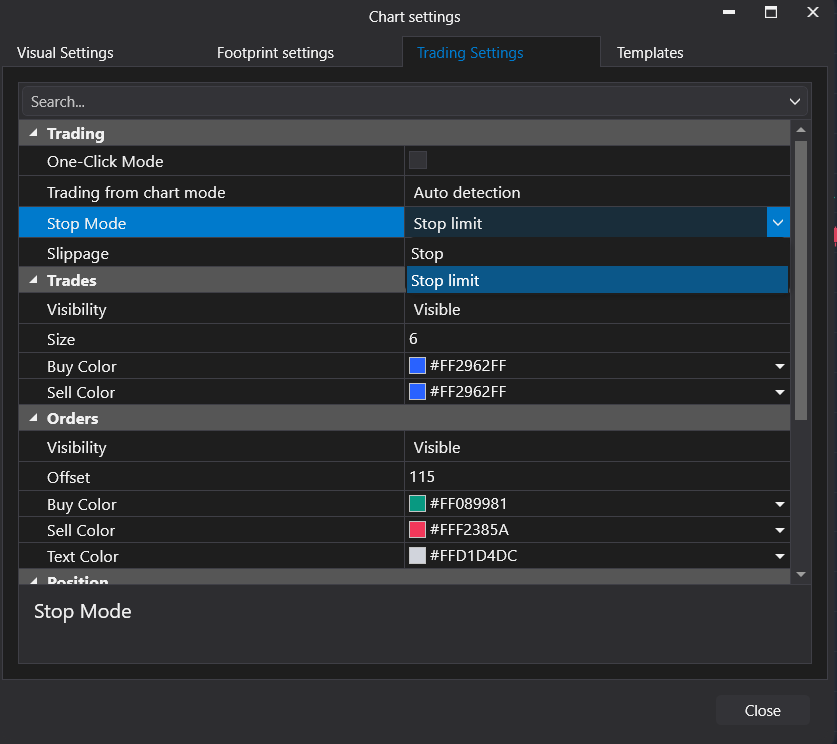
Stop Mode defines which type of stop order ATAS uses when a stop order is placed from the chart.
Available modes:
- Stop — ATAS places a regular stop order.
- Stop Limit — ATAS places a stop-limit order.
If Stop Limit is selected, ATAS uses the clicked price as the trigger price and calculates the limit price using the Slippage value.
Slippage
Slippage is used for stop-limit orders. It defines the distance between the stop trigger price and the limit price.
The value is calculated in instrument ticks:
- for buy stop-limit orders, the limit price is placed above the trigger price;
- for sell stop-limit orders, the limit price is placed below the trigger price.
For example, if Slippage is set to 5, the stop-limit order limit price is offset by 5 ticks from the trigger price.
Trades
The Trades group controls how your executed trades are displayed on the chart.
Available settings:
- Visibility — controls whether trades are shown on the chart.
- Size — controls the size of trade markers.
- Buy Color — sets the color for buy trades.
- Sell Color — sets the color for sell trades.
Visibility options:
- Visible — trades are always shown on the chart.
- Hidden — trades are not shown on the chart.
- Visible When Trading Panel Is Enabled — trades are shown only when Trading Panel is active.
These settings affect chart visualization only. They do not remove trades from account history or trading reports.
Orders
The Orders group controls how active orders are displayed on the chart.
Available settings:
- Visibility — controls whether active orders are shown on the chart.
- Offset — controls how far order labels are drawn from the price axis.
- Buy Color — sets the color for buy orders.
- Sell Color — sets the color for sell orders.
- Text Color — sets the color of order label text.
Visibility options:
- Visible — active orders are always shown on the chart.
- Hidden — active orders are not shown on the chart.
- Visible When Trading Panel Is Enabled — active orders are shown only when Trading Panel is active.
These settings change only the display of orders on the chart. They do not cancel, modify, or hide orders in the Orders window.
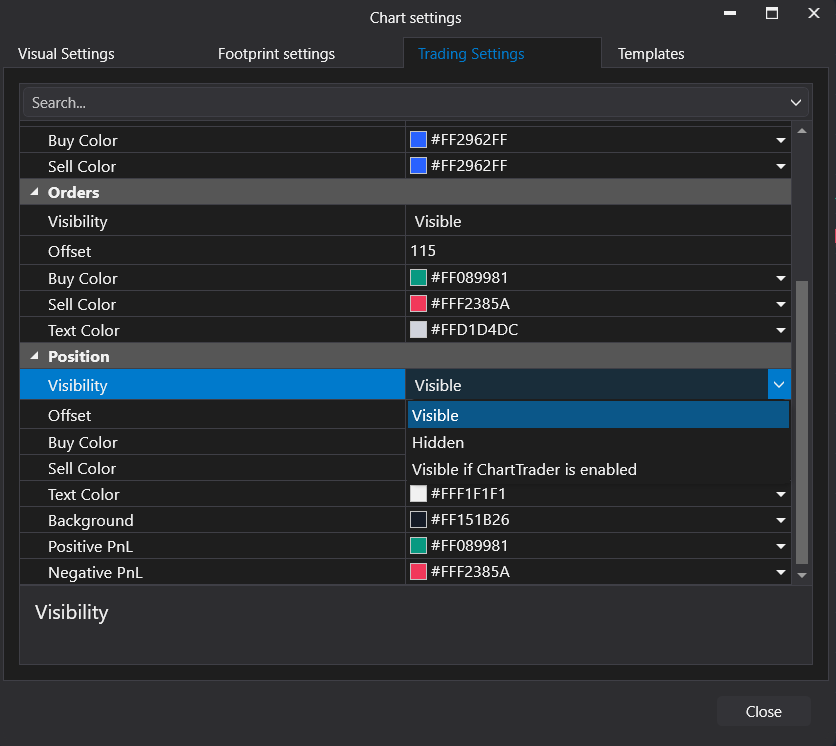
Position
The Position group controls how the current open position is displayed on the chart.
Available settings:
- Visibility — controls whether the current position is shown on the chart.
- Offset — controls how far the position label is drawn from the price axis.
- Text Color — sets the color of the position label text.
- Background — sets the background color of the position label.
- Positive PnL — sets the color for positive PnL values.
- Negative PnL — sets the color for negative PnL values.
Visibility options:
- Visible — the position is always shown on the chart.
- Hidden — the position is not shown on the chart.
- Visible When Trading Panel Is Enabled — the position is shown only when Trading Panel is active.
These settings affect only the visual representation of the position on the chart. They do not change the position itself.
Important Notes
- Trading settings are chart-specific and can be saved with chart templates or workspaces.
- Some trading actions depend on the selected connection, broker, account permissions, and instrument.
- One-click trading increases execution speed but also increases the risk of accidental order submission.
Was this article helpful?
That’s Great!
Thank you for your feedback
Sorry! We couldn't be helpful
Thank you for your feedback
Feedback sent
We appreciate your effort and will try to fix the article