Watchlist is a module for monitoring selected instruments. It allows you to create a working list of futures, stocks, cryptocurrency pairs, and other markets, view current quotes, and quickly open the required instrument in other ATAS modules.
Watchlist is convenient to use as a starting point for a workspace: the trader can see a list of important instruments, monitor price and volume changes, and then quickly open a chart, Smart DOM, Smart Tape, or another module for the selected instrument.
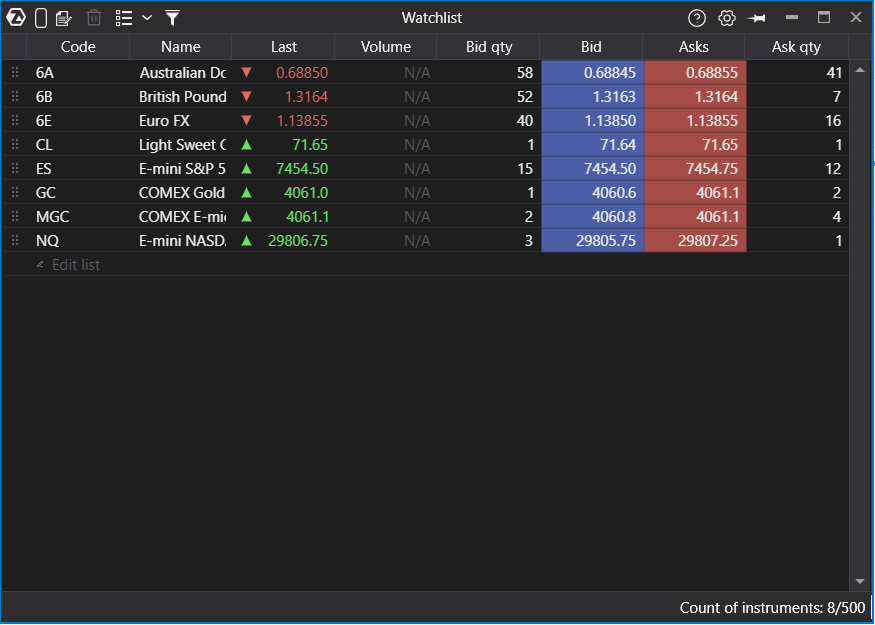
What Watchlist is used for
- quickly monitoring multiple instruments in one window;
- keeping separate lists for different markets or trading scenarios;
- quickly opening the selected instrument in Chart, Smart DOM, and other modules;
- comparing instruments by price, volume, price change, bid/ask, and other available columns;
- filtering the list by conditions when only suitable instruments need to be displayed.
How to open Watchlist
- Open the Watchlist module in the ATAS workspace.
- Add instruments manually or select a ready-made list.
- Configure the columns and instrument order according to your trading scenario.
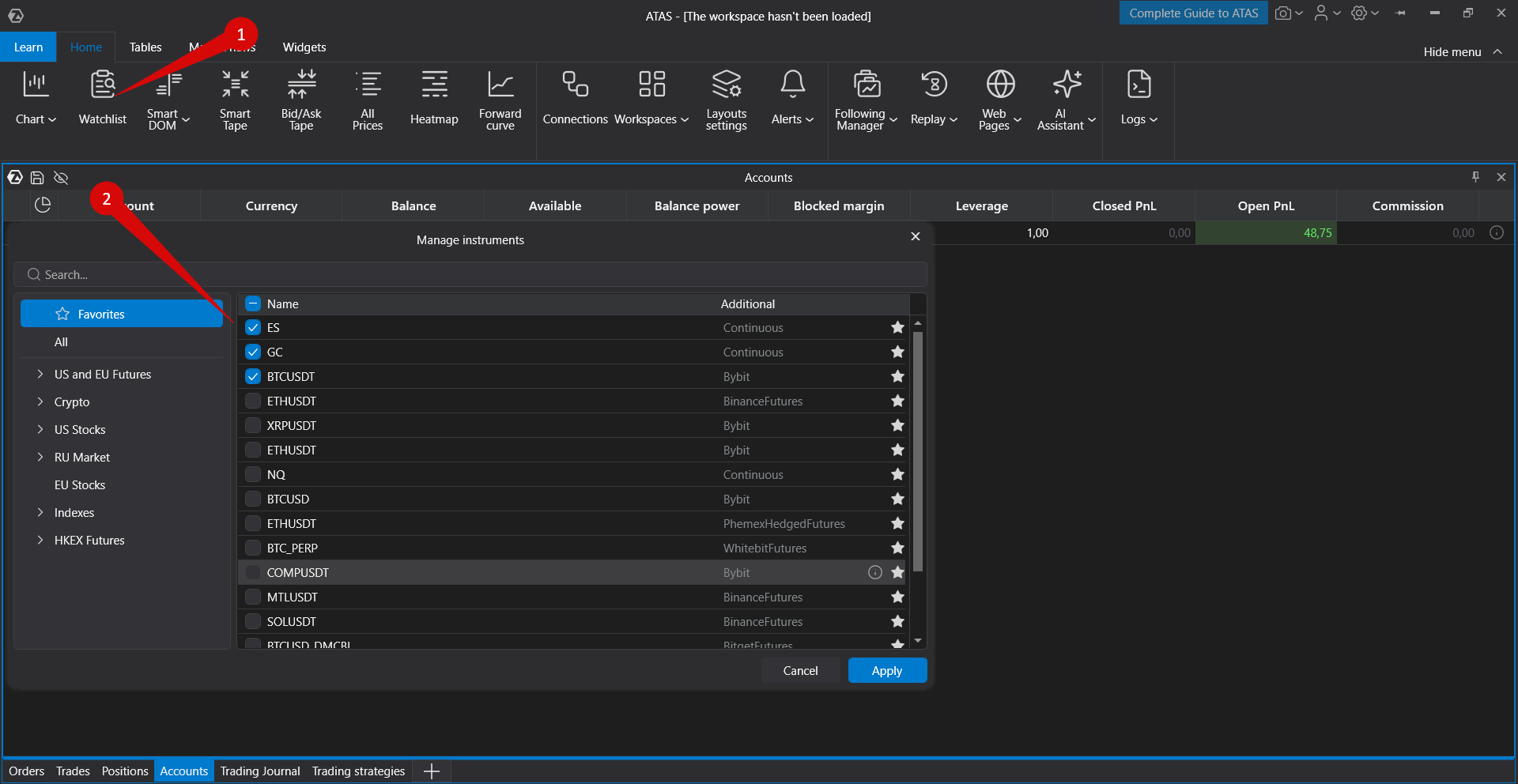
If there is no data for an instrument from the connected data source, some values in the table may not update. Watchlist requires available market data for the selected instruments.
Adding instruments
To add an instrument to Watchlist, use the Add instrument action. After selecting the instrument, it will appear in the list and start displaying the available data.
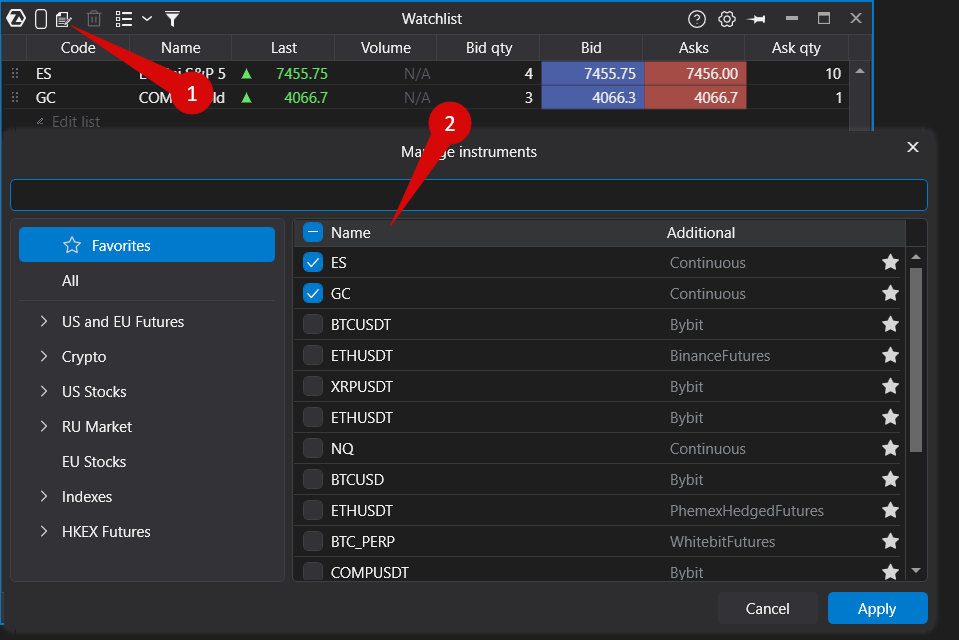
Example
If a trader monitors U.S. futures, they can add ES, NQ, and CL to one Watchlist and keep them next to each other in the workspace.
If the selected instrument is already in the list, the platform displays a warning that it is already being monitored. This helps avoid duplicating the same ticker.
Replacing an instrument in a row
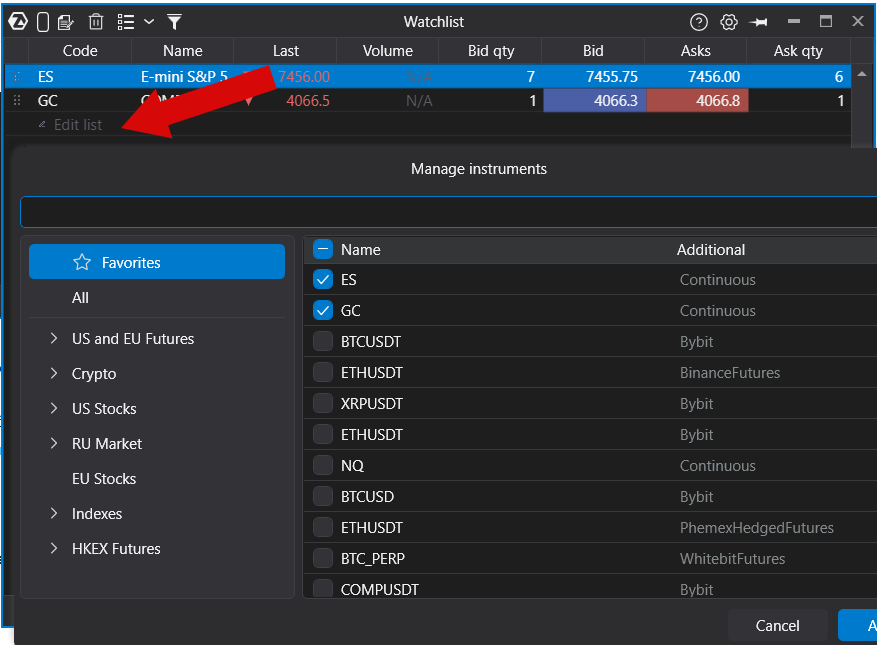
An instrument in an existing row can be replaced by selecting a new instrument. In the current workflow, this is done through the Watchlist row and the instrument manager: the user selects another instrument, and the row is updated.
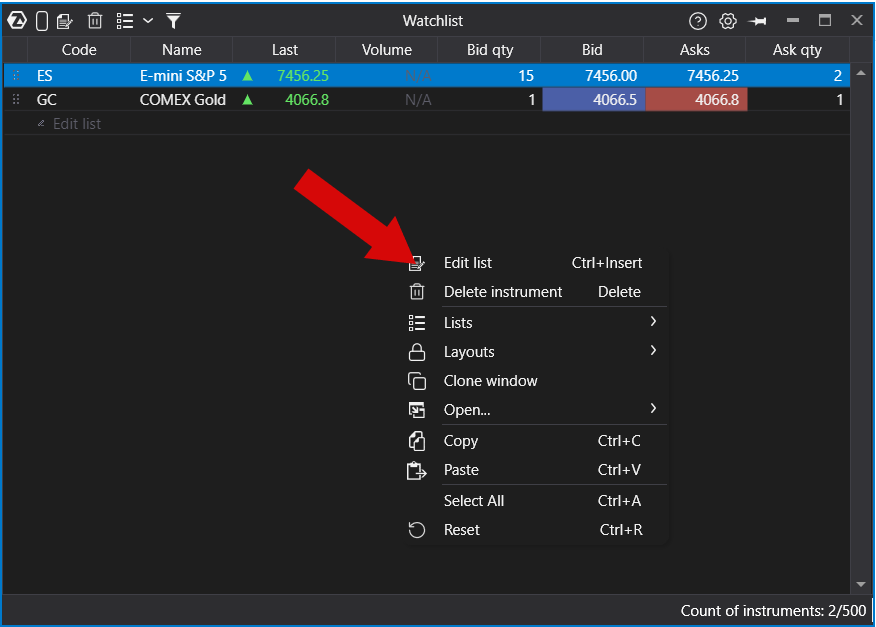
Adding through the bottom row
The Add instrument row may be displayed at the bottom of the list. When this row is selected, the instrument manager opens, and the new instrument is added to the end of the list.
Removing instruments
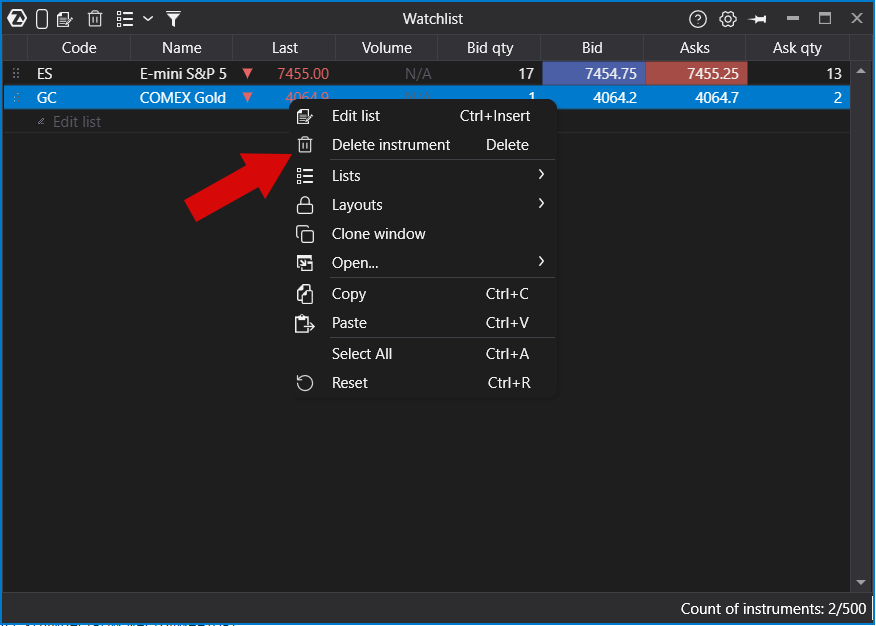
To remove an instrument from the list, select the row, right-click it, and use the Remove instrument action.
Number of instruments
A status row with the number of added instruments and the list limit may be displayed at the bottom of Watchlist.
Working with lists
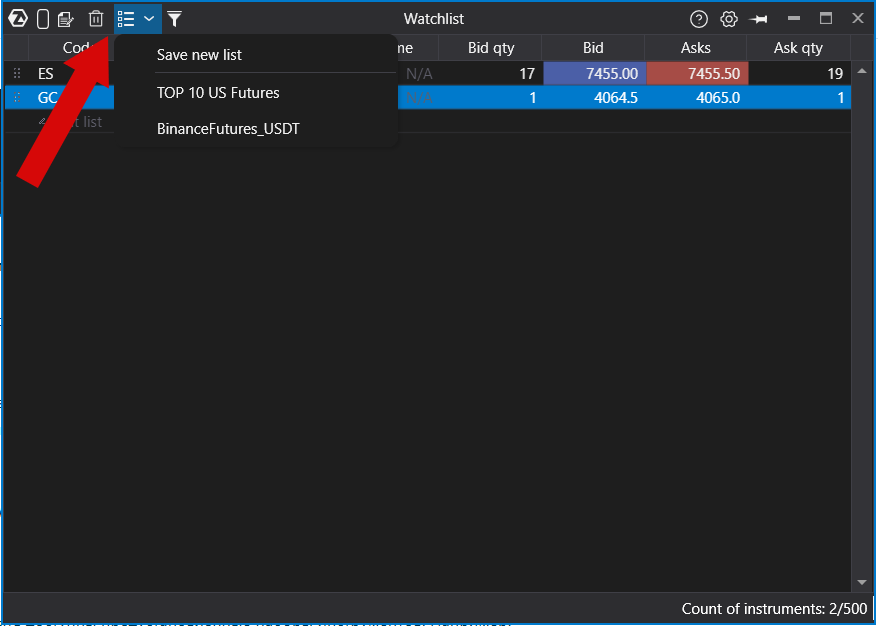
In Watchlist, you can work not only with individual instruments but also with lists. This is useful when the user has different sets for different markets: for example, a separate list for U.S. futures, a separate list for cryptocurrencies, and a separate list for instruments monitored today.
Ready-made lists
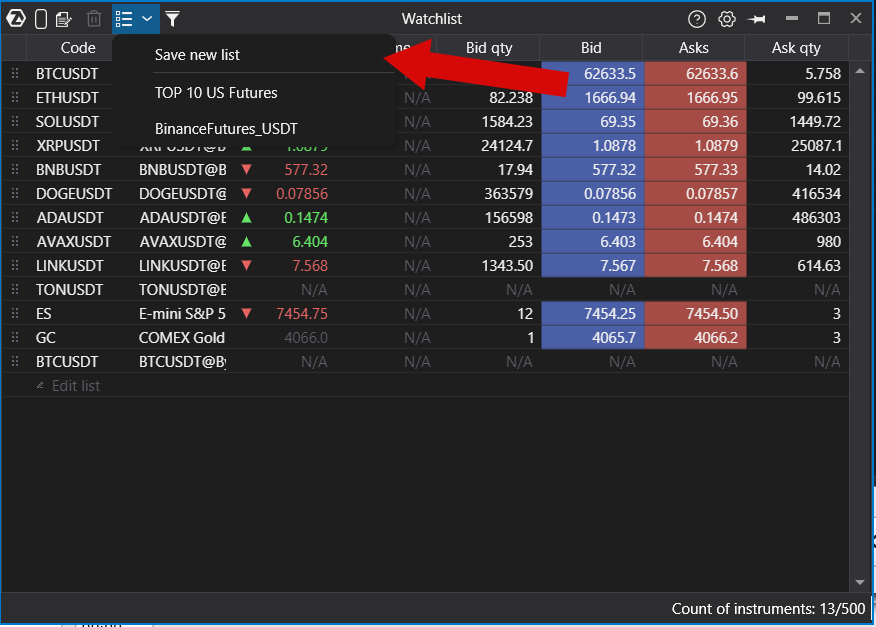
Preset instrument lists may be available in the list menu. For example:
- TOP 6 with delayed — delayed instruments, if the corresponding data source is connected;
- TOP 10 US Futures — popular U.S. futures;
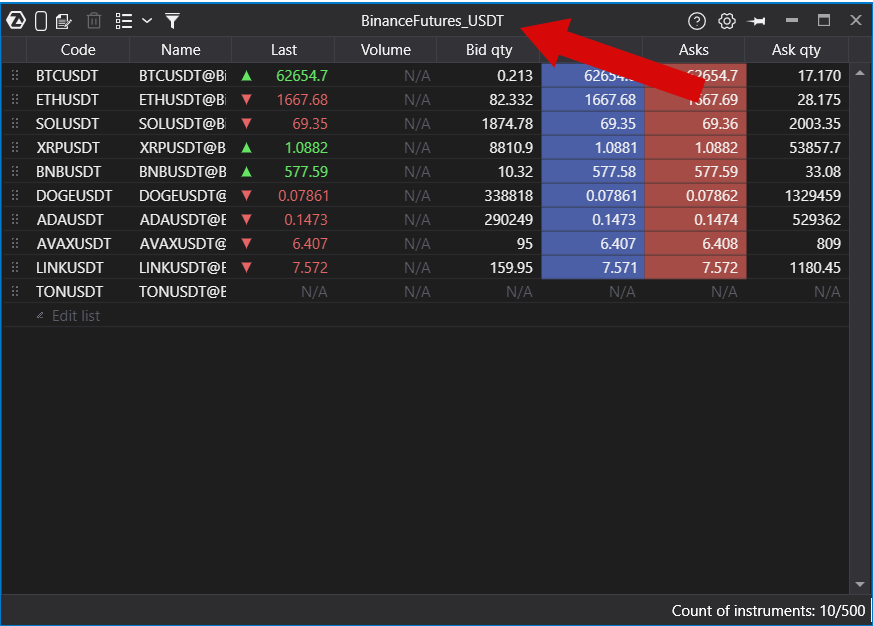
- BinanceFutures_USDT — a limited list of popular crypto pairs against USDT.
After a ready-made list is selected, Watchlist loads the corresponding set of instruments and changes the module title to the name of the selected list.
Saving a custom list
If the user manually added instruments or changed a ready-made list, they can save the result as a custom list.
How to save a list
- Collect the required instruments in Watchlist.
- Open the list menu.
- Select Save new list.
- Enter the list name.
- Save the list.
Columns and data
Watchlist displays instrument data as a table. The set of available columns depends on the platform version, instrument type, and data source.
- Last — the last price;
- Bid qty and Ask qty — the available volume at the best bid/ask;
- Vol. Last Trade — the volume of the last trade;
- Volume, Change, Change% — fields useful for comparing instruments and filtering.
Example
A trader can sort the list by price change or volume and quickly see instruments with increased activity.
Quote filter
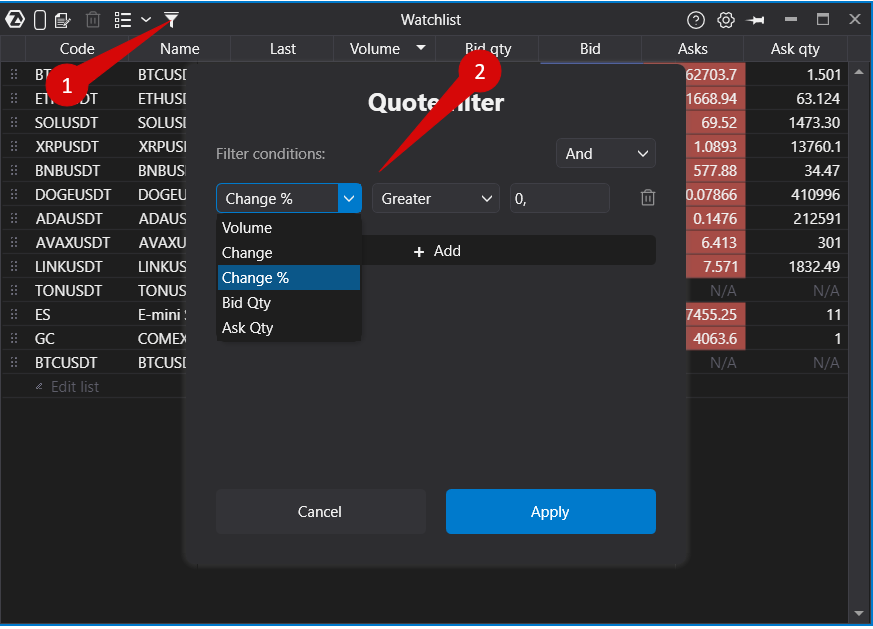
The filter helps keep only the instruments that match the specified conditions in Watchlist. This is useful when the list is large and the user needs to quickly find instruments with noticeable movement or volume.
What can be filtered
- Volume — volume;
- Change — price change;
- Change% — price change in percent;
- BidQty — volume at the bid;
- AskQty — volume at the ask.
The conditions use comparisons: greater than, less than, or equal to the selected value.
Example
You can keep only instruments where Change% is above the specified value or only instruments with volume above the selected threshold.
Dragging instruments
Instruments can be dragged inside Watchlist to change the row order. An instrument can also be dragged from Watchlist to a supported module to open it there.
Example
If Watchlist contains ES, NQ, and CL, the user can drag NQ onto a chart, and the chart will switch to this instrument. The user can also quickly move NQ higher in the list if this instrument is currently more important.
Opening modules from Watchlist
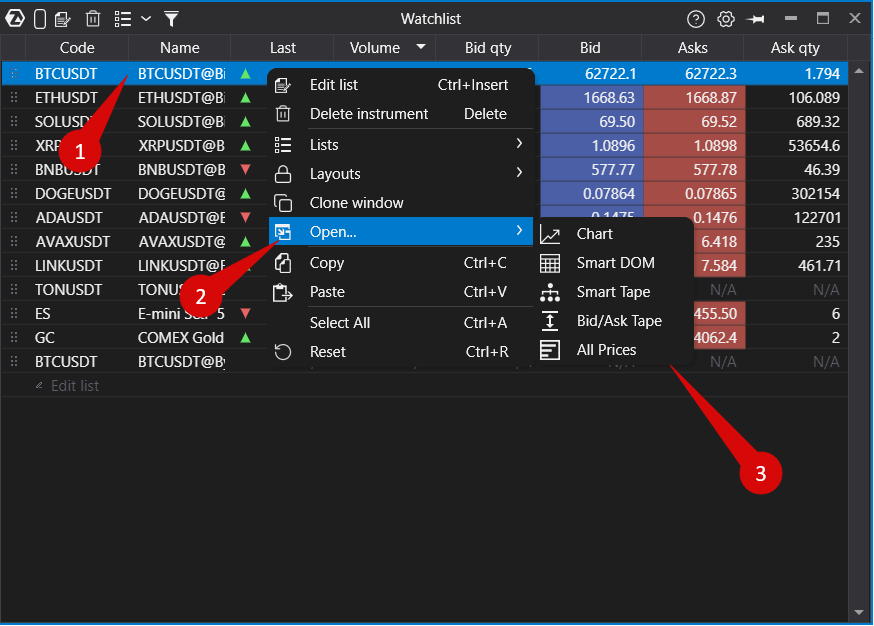
From Watchlist, the selected instrument can be opened in other modules. This speeds up the workflow: the user first finds the instrument in the list and then immediately opens the required view. To open a module through Smart DOM, right-click the required instrument and select Open → Smart DOM or another required module.
Example
The user sees that the volume has increased for an instrument, opens a chart for analysis, and then opens Smart DOM to work with the order book.
Copying, pasting, and resetting
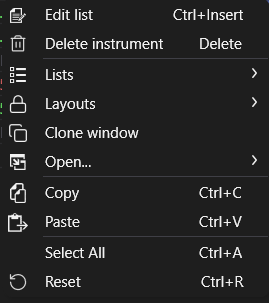
The Watchlist context menu contains standard actions for working with the table:
- Copy — copy the selected rows;
- Paste — paste data if this is supported in the current scenario;
- Select All — select all rows;
- Reset — reset the table or view settings.
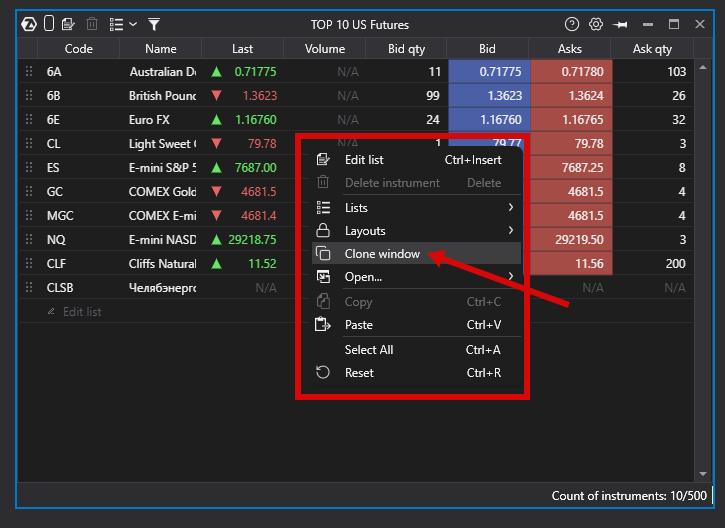
Cloning Watchlist
Watchlist can be cloned to quickly create a second window with a similar configuration. This is convenient when you need to keep two lists side by side: for example, one for futures and another one for cryptocurrencies.
Status row
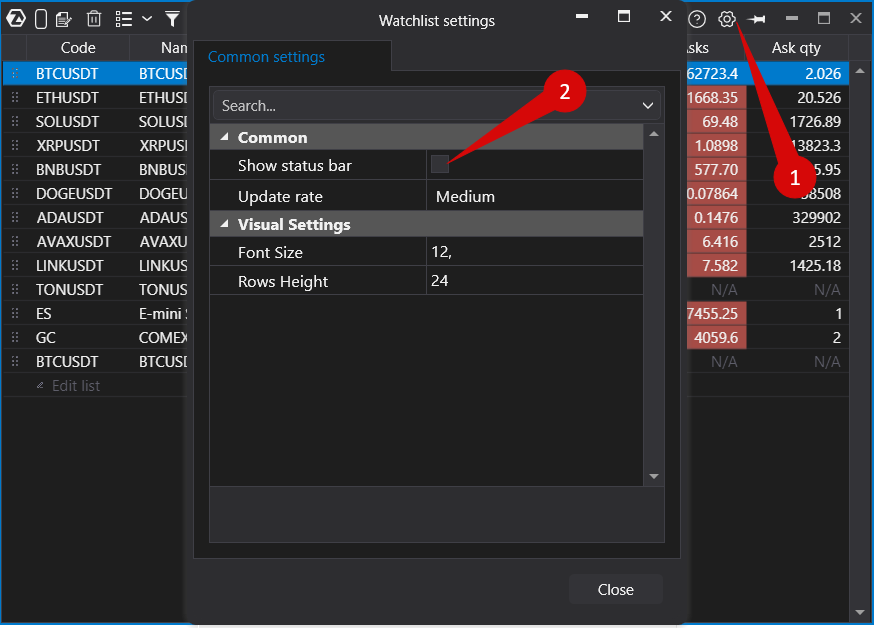
In Watchlist settings, the status row can be enabled or hidden. It is located at the bottom of the module and helps display service information, such as the number of instruments in the list.
Notes
- Data in Watchlist depends on the connected data source and the availability of the specific instrument.
- Some ready-made lists may be displayed only when the corresponding instruments or connection are available.
- If an instrument is already in Watchlist, the platform will warn that it is already being monitored.
Was this article helpful?
That’s Great!
Thank you for your feedback
Sorry! We couldn't be helpful
Thank you for your feedback
Feedback sent
We appreciate your effort and will try to fix the article