Common Settings
Common Settings contain platform-wide parameters that affect charts, volume profiles, DOM depth, rendering, backups, latency notifications, trading warnings, and local cache.
Use this window to adjust general platform behavior rather than the settings of a single chart, indicator, or trading module.
Opening Common Settings
To open Common Settings:
- Open the main ATAS window.
- Go to Settings.
- Select Common Settings.
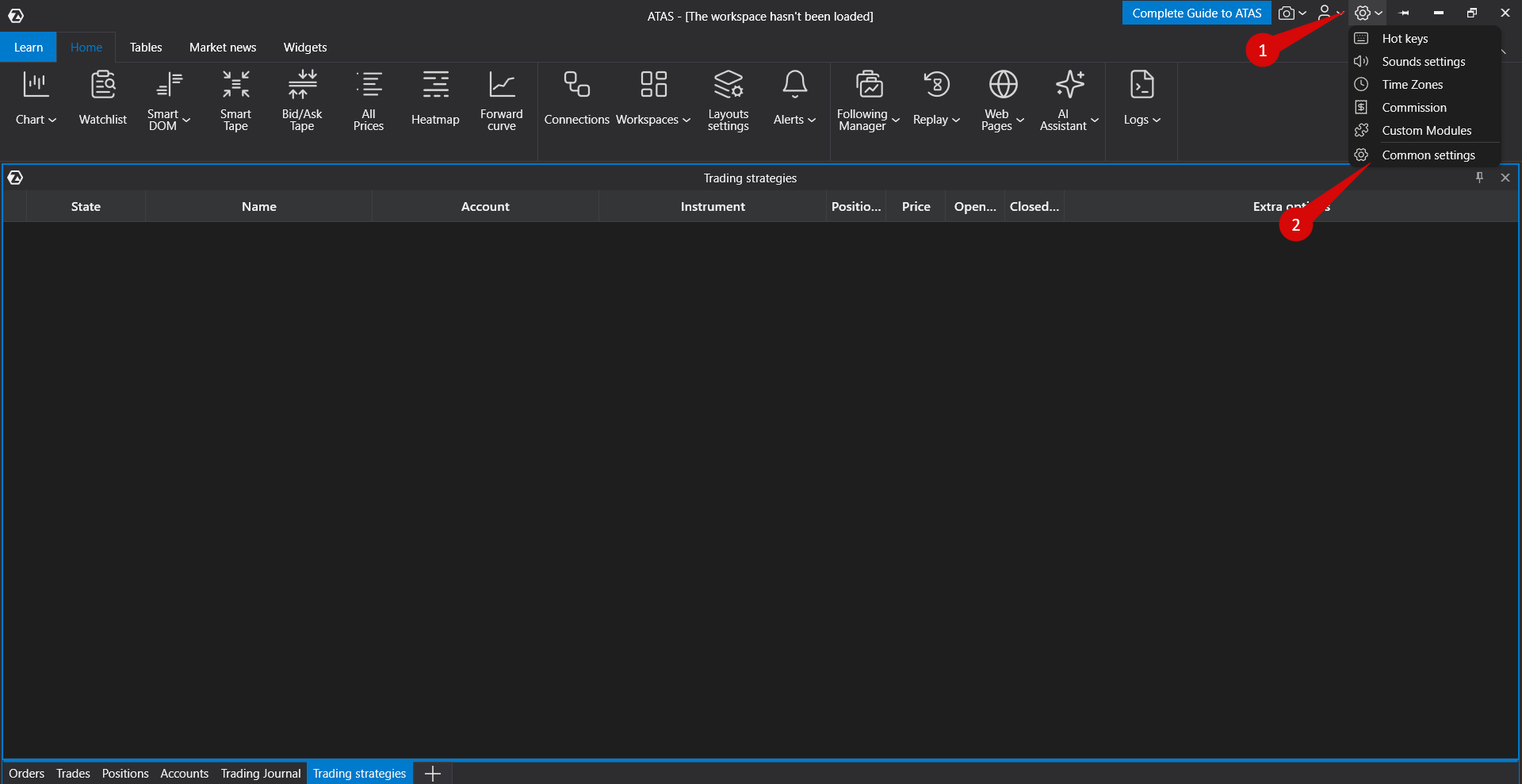
The Common Settings window contains grouped platform parameters and action buttons at the bottom of the window.
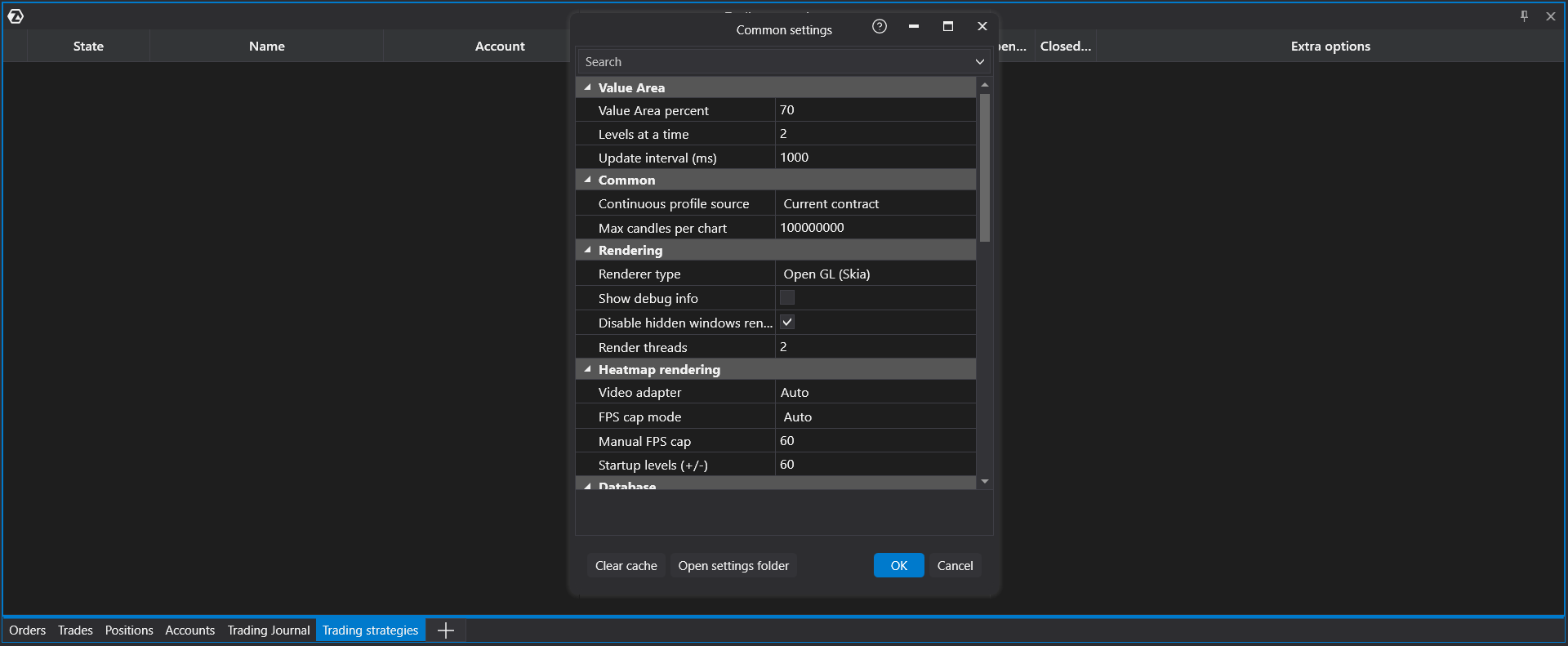
Value Area Settings
The Value Area group controls how Value Area is calculated for platform tools that use volume profile data.
- Value Area Percent — sets the percentage of total volume used to calculate the Value Area. The default value is usually 70%.
- Levels at a Time — defines how many price levels are compared during Value Area calculation. Lower values improve calculation detail and accuracy but require more processing power; higher values reduce precision and server load
- Update Interval — controls how often Value Area is recalculated. Increasing this value can reduce CPU load when candles update frequently.
Common Settings Parameters
Continuous Profile Source — defines which data source is used for profiles on continuous contracts.
Current Contract — calculates the profile only from the currently selected contract.
Continuous Contract / All Period — calculates the profile from continuous contract data.
Max Candles per Chart — limits the number of candles displayed on a chart. Lower values can reduce memory usage and speed up chart loading.
If you're trying to load many days on a small timeframe, you'll need to increase the value of Max Candles per Chart
Depth of Market
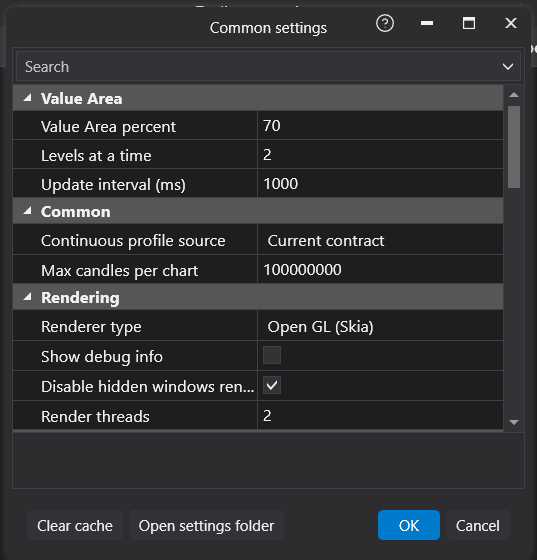
The Levels Count setting limits the number of visible DOM price levels.
Set Levels Count to 0 to remove the DOM level limit and display all levels provided by the data source.
If you use many instruments or a heavy workspace, limiting the number of DOM levels can reduce the amount of processed data and improve performance.
Rendering
The Rendering group controls how charts and visual modules are drawn. Depending on the platform version and operating system, some rendering settings may be shown or hidden.
Renderer Type — selects the rendering engine. Available options may include Direct2D, GDI, and OpenGLSkia.
- OpenGLSkia — uses GPU resources and is required for some Liquidity Map features in DOM Levels or DOM Trader.
- Direct2D — uses hardware acceleration (GPU) for fast, high-quality 2D graphics rendering and smooth UI performance.
- GDI — relies on standard CPU rendering for basic graphics, ensuring maximum compatibility with older hardware or virtual environments.
Show Debug Info — displays rendering debug information in platform windows.
Disable Hidden Windows Rendering — stops rendering windows that are hidden behind other windows. This can reduce GPU load when the platform is running.
Render threads — specifies the number of CPU threads used to render charts. Increase this value for smoother performance if you have free CPU cores, or lower it to reduce overall CPU load when running multiple charts.
Some rendering changes require restarting the platform before they are fully applied.
Heatmap rendering
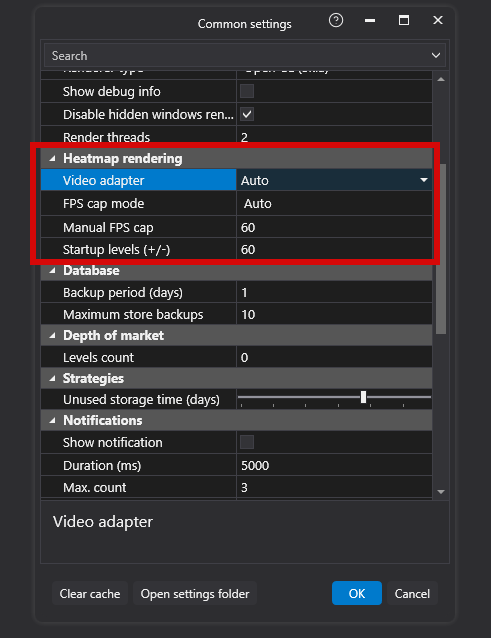
Heatmap rendering — settings for rendering and optimizing the display of the heatmap / Liquidity Map on charts.
Video adapter — selects the graphics card (GPU) used for processing and rendering the heatmap. Auto mode automatically detects and uses the primary discrete or integrated GPU.
FPS cap mode — manages the frame rate limit for the heatmap display. In Auto mode, the system dynamically adjusts FPS based on display settings and system performance.
Manual FPS cap — sets a strict frame rate limit (e.g., 60 FPS) when manual capping is active, helping to balance rendering smoothness with GPU resource consumption.
Startup levels (+/-) — specifies the initial number of price levels (above and below the current market price) loaded for the heatmap upon chart startup to optimize initial load times.
Strategies
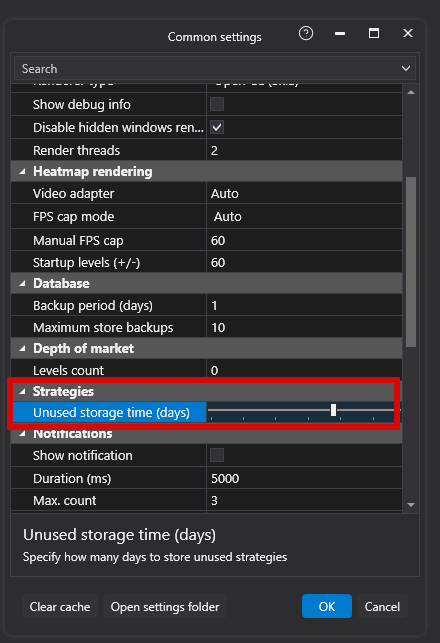
Unused storage time (days) — sets the retention period (in days) for inactive or unused trading strategies before they are automatically cleared from storage to free up disk space.
Database
The Database group controls local platform backups.
- Backup Period (days) — defines how often the platform creates a local database backup.
- Maximum Store Backups — defines how many backup copies are kept on your device.
Data Delays
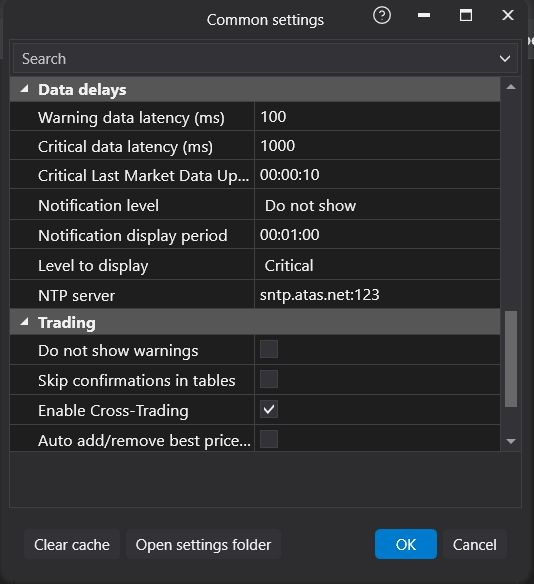
The Data Delays or latency group controls warnings about market data and order delays.
- Warning Data Latency (ms) — sets the delay threshold for warning-level notifications.
- Critical Data Latency (ms) — sets the delay threshold for critical notifications.
- Critical Last Market Data Update — sets the maximum allowed time since the last market data update.
- Notification Level — defines which latency notifications are shown.
- Notification Display Period — controls how often recurring delay notifications are displayed.
- Level to Display — defines which delay level is shown on charts or diagrams.
- NTP Server — defines the time server used for latency checks.
Use these settings carefully. Very low latency thresholds can cause frequent notifications, especially when the internet connection or data provider is unstable.
Trading
The Trading group contains platform-wide options related to order management and trading confirmations.
- Do Not Show Warnings — disables SL/TP order warnings during trading and ignores related SL/TP warning messages.
- Skip Confirmations in Tables — skips confirmation dialogs when cancelling orders or closing positions from tables such as Orders, Positions, or Trading Activity.
- Enable Cross-Trading — allows the platform to place trades on a different instrument than the one displayed in the chart or Smart DOM. For example, you can analyze ES while routing trades to MES, if the feature and instrument mapping are available.
- Auto add/remove best prices indicator — automatically adds or removes the Cross Trading Best Prices indicator on charts when cross-trading is activated or deactivated.
Before disabling warnings or confirmations, make sure you understand how these actions affect live trading.
Notifications
Common Settings also include desktop notification settings.
- Show Notification — enables or disables desktop notifications.
- Duration — defines how long a notification stays visible.
- Max. Count — defines how many notifications can be visible at the same time.
- Position — defines where notifications appear on the desktop.
If this group is not displayed in your Common Settings window, notification behavior may be managed by your operating system or another platform settings section.
Closing Modules
In some platform versions, the Closing Modules group allows you to disable confirmation prompts when closing platform modules.
- Don’t Ask Again — disables the closing confirmation permanently.
- Don’t Ask Today — disables the closing confirmation only for the current day.
Clear Cache
Use Clear Cache when charts or market depth data load incorrectly, old local data causes issues, or ATAS Support asks you to clear the local cache.
This action clears locally cached market data, including DOM-related cache. After clearing the cache, the platform may need to reload data from the data source.
Open Settings Folder
Use Open Settings Folder to open the local folder where platform settings are stored.
ATAS Support may ask you to open this folder when troubleshooting settings, workspaces, or local configuration files.
Saving Changes
Click OK to save changes. Click Cancel to close the window without applying changes.
If a setting requires a restart, ATAS displays a notification that the platform must be restarted before the change is fully applied.
Important Notes
- Common Settings affect the whole platform, not only one chart or module.
- Some settings can affect performance, memory usage, or trading behavior.
- Available groups and options may differ depending on the platform version
- If you are not sure which value to use, keep the default setting or contact ATAS Support.
Was this article helpful?
That’s Great!
Thank you for your feedback
Sorry! We couldn't be helpful
Thank you for your feedback
Feedback sent
We appreciate your effort and will try to fix the article